AI Server & Data Center Connectors
AI Server & Data Center Connectors
Articles
12 entries
EDSFF Connectors Explained: E1.S vs E3.S for OCP Server Storage
Compare EDSFF E1.S and E3.S storage connector form factors, examining SFF-TA-1002 edge interface pins, thermal airflow advantages, and high-density NVMe drive integration.

CRPS Explained: OCP's Common Redundant Power Supply Connector Standard
Explore the CRPS (Common Redundant Power Supply) connector interface, featuring card-edge pin assignment breakdown, hot-swapping mechanisms, and server chassis design.

OCP OAM Connectors Explained: Accelerator Module Interconnect Design
Discover how OCP Open Accelerator Module (OAM) high-density mezzanine connectors handle high-speed interconnects, massive power delivery, and thermal tolerances in AI processing systems.

OCP Open Rack Busbar Power Connectors: ORv2 vs ORv3 Explained
Compare OCP Open Rack ORv2 and ORv3 busbar power connector architectures, examining 12V vs 48V current density, blind-mate tolerance, and contact design.
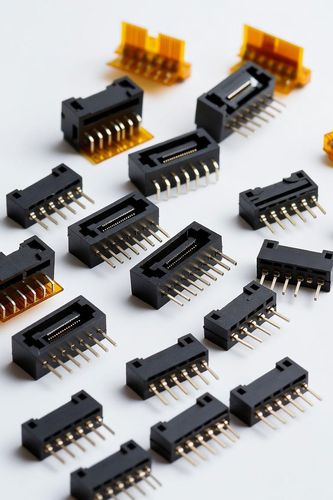
OCP DC-SCM Explained: The Data Center Secure Control Module Connector Interface
A detailed engineering guide to the OCP Data Center Secure Control Module (DC-SCM) connector interface, exploring board-to-board decoupling, high-speed signals, and server management physical design.

Copper vs. optical in high-speed data links
Compare Direct Attach Copper, Active Optical Cables, and pluggable transceivers at 112G and 224G PAM4. Evaluate reach, power consumption, latency, and cost trade-offs.

Mezzanine connectors explained: Applications in servers
Explore high-density mezzanine connectors in server architectures. Learn board-to-board stack height optimization, 112G/224G PAM4 BGA interfaces, hermaphroditic contact designs, and signal integrity rules.

High-speed backplane connectors
Explore backplane connector architectures for modular chassis switches and AI compute nodes. Compare traditional, direct orthogonal, and cabled backplane topologies at 112G/224G PAM4.

800G Ethernet interconnects and form factors
Compare OSFP and QSFP-DD form factors powering 800G Ethernet in AI clusters. Evaluate thermal dissipation, backward compatibility, and port density trade-offs.

PCIe Gen5 connector selection guide
A practical guide for choosing PCIe Gen5 connectors. Evaluate CEM card edge, SFF-TA-1002 (EDSFF), and Gen5 flyover cable options across insertion loss and layout constraints.

GPU server connectors explained
Discover the physical connector standards powering GPU servers. Learn SXM, OAM mezzanine form factors, 12VHPWR/12V-2x6 power connections, and high-speed fabric routing.

PCIe connectors explained: Gen4 vs Gen5 vs Gen6
Compare PCIe Gen4, Gen5, and Gen6 card edge connectors. Analyze the jump from 16 GT/s to 64 GT/s, NRZ to PAM4 signaling transitions, and tight channel loss budgets.