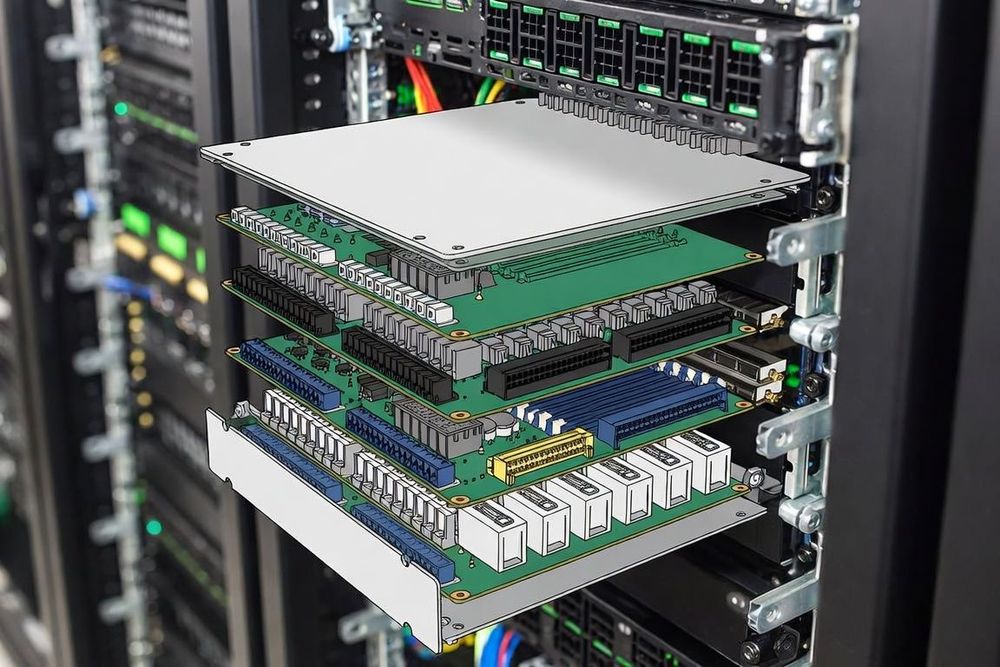
Parallel Board Stacking in Modern Compute Density
Mezzanine connectors are high-density, board-to-board interconnect systems designed to stack parallel printed circuit boards vertically within a server chassis. As cloud data centers and AI clusters collapse compute density into tighter 1U to 4U rack footprints, mezzanine connectors allow hardware designers to attach high-performance daughtercards—such as CPU memory expansion modules, OCP NIC 3.0 network cards, and GPU accelerator baseboards—directly onto a primary system motherboard.
At data rates reaching 112 Gbps and 224 Gbps PAM4 per lane, modern mezzanine interconnects must function as near-transparent electrical bridges. They must preserve tight differential impedance matching across array footprints containing hundreds of signal pins while enduring severe physical thermal expansion and mechanical assembly forces.
Core Architectural Features and Contact Designs
High-speed mezzanine connectors incorporate specialized mechanical and electrical features to overcome high-frequency degradation across stacked PCBs:
1. Ball Grid Array (BGA) Surface Attachment
Unlike traditional surface-mount technology (SMT) lead legs, high-speed mezzanine receptacle housings integrate pre-attached solder balls arranged in a Ball Grid Array (BGA) matrix.
Engineering Impact: BGA mounting eliminates lead-inductance stubs and provides uniform high-density signal and ground pin pitch (0.60mm to 0.80mm). This allows automated surface-mount assembly equipment to reflow hundreds of differential pairs directly over solid ground vias on the motherboard.
2. Hermaphroditic and Self-Aligning Mating Interfaces
When joining large daughterboards with multiple mezzanine connectors simultaneously, mechanical tolerances can cause microscopic pin misalignments.
Engineering Impact: Advanced mezzanine designs (such as Amphenol Celerity or Molex Gemini) utilize hermaphroditic (self-mating) contact geometries. The plug and receptacle share identical mating faces with integrated lead-in chamfers that self-align the boards during assembly, eliminating the risk of stubbing or bending delicate contacts.
3. Variable Stack Height Profiles
Server airflow dynamics and component heights vary widely across 1U compute sleds and thick GPU heatsink assemblies.
Engineering Impact: Mezzanine families offer scalable stack heights ranging from low-profile 4mm to 5mm heights (for space-constrained accelerator modules) up to 11mm to 40mm heights using interposer blocks (for tall component clearance and optimized airflow).
Hardware Design and Signal Integrity Rules
When laying out high-speed mezzanine connector footprints on multi-layer server PCBs:
- Enforce Strict Board Coplanarity: High-pin-count BGA mezzanine connectors require exceptional PCB flatness across the entire solder pad area. Specify maximum board warp limits of 0.50% or less across the connector region to prevent open solder joints or bridging during SMT reflow.
- Match System Impedance Goals (85Ω vs 92Ω vs 100Ω): Select connector contact configurations matched to your primary interface target. Modern 224G mezzanine connectors offer nominal 92Ω impedance profiles designed to cleanly bridge both 85Ω (PCIe/CXL) and 100Ω (Ethernet) system designs with minimal reflection loss.
- Implement Ground Pin Guard Bands: To minimize near-end crosstalk (NEXT) in ultra-dense BGA footprints, surround every high-speed differential signal pair with a continuous perimeter of ground vias (a Ground-Signal-Signal-Ground pinout layout).