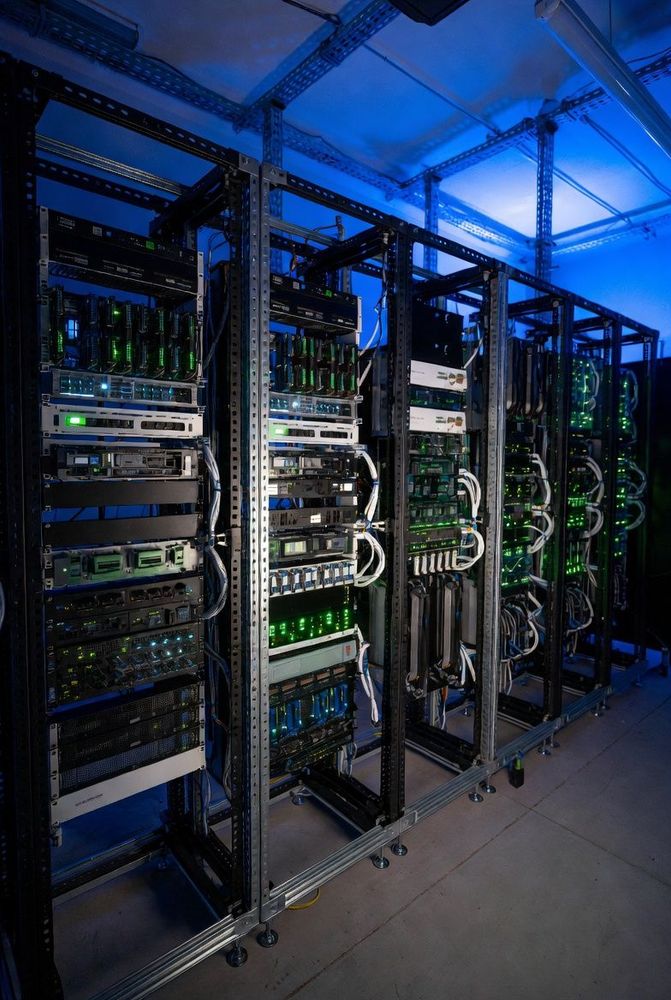
An OCP server is a server built to a specification published by the Open Compute Project (OCP), an organization where companies share open data center hardware designs. The main difference from a conventional server is the rack around it. Open Rack takes wider chassis than a 19-inch rack, and Open Rack V3 (ORv3) feeds them from a shared 48 V DC busbar instead of a separate power supply in every server.
In short:
- OCP is a set of open hardware specifications, not a single product or a single connector.
- Open Rack keeps the same outside footprint as a standard rack but fits equipment up to 537 mm (21 in) wide.
- For connector selection, the changes show up in rack power, network cards, management modules, storage and liquid cooling.
What Is the Open Compute Project?
The Open Compute Project began inside Facebook (now Meta) as an internal effort and was announced publicly on April 7, 2011. Its stated purpose is to let companies share data center product designs and best practices. Today it publishes specifications and design contributions for racks, power, servers, storage, networking, management and cooling.
"Open" here means the specifications are published so that any supplier can build to them. A buyer can then compare products from different makers that follow the same interface, which is also why connector standardization matters so much in OCP hardware. For the connector side of the specifications, see our guide to OCP and ORv3 compliant connectors.
What Makes a Server an OCP Server?
There is no single test, because OCP covers many separate specifications. A server counts as an OCP server when it follows the relevant published OCP specifications. Three design ideas appear again and again.
- Shared rack power. Instead of an AC power supply in every server, the rack has a power shelf that feeds a busbar, and the servers take DC power from it. This reduces duplicated power hardware inside each chassis.
- A wider chassis. Open Rack allows equipment up to 537 mm (21 in) wide, which leaves more room for components and airflow.
- Standard modules. Network cards, management modules, power supplies and drives follow published form factors so that parts from different suppliers can be swapped.
OCP Accepted and OCP Inspired
OCP uses two recognition labels for products. According to OCP's program description, a product is OCP Inspired when it complies with an approved OCP specification or another type of contribution but no design files have been contributed. A product is OCP Accepted when it complies with an approved OCP specification and design files have been contributed. When a data sheet says "OCP-compliant", ask which specification it means and which label applies.
Before you rely on an "OCP" claim from a supplier, ask three questions:
- Which OCP specification and revision does the product follow (for example Open Rack V3, OCP NIC 3.0 or DC-SCM)?
- Is the product OCP Accepted or OCP Inspired, and where is that listed?
- Which connector part numbers does the specification call for, and does the supplier's connector match them exactly?
Our ORv3 connector compliance checklist goes through these questions in more detail.
OCP vs Traditional Racks
Open Rack was designed to replace the standard 19-inch rack for large deployments. It keeps the same outside width and depth as existing racks, so it fits the same floor space, but it uses the inside of the cabinet differently.
- Outside footprint — Open Rack: Same width and depth as existing racks; Traditional 19-inch rack: Standard
- Usable equipment width — Open Rack: Up to 537 mm (21 in); Traditional 19-inch rack: 19 in
- Vertical unit — Open Rack: OpenU (OU): 48 mm, or 1.89 in; Traditional 19-inch rack: Rack unit (RU): 1.75 in
- Power delivery — Open Rack: Shared DC busbar fed by a power shelf (ORv3: 48 V DC); Traditional 19-inch rack: Typically an AC power supply in each server
- Mixed equipment — Open Rack: ORv3 can mount 21-inch OU or 19-inch RU equipment; Traditional 19-inch rack: 19-inch equipment
According to one summary of the ORv3 design, the standard power shelf is rated 15 kW N+1 (30 kW N+1 with a dual shelf), built from six 3 kW rectifiers per shelf, and the design targets up to 30 kW per rack enclosure. Treat these as headline figures and confirm them in the current Open Rack V3 specification before you design to them.
Not every OCP-derived design uses Open Rack. Some designs use a more traditional 19-inch rack with a rack power distribution unit supplying AC power to the servers. That is one reason to check the exact rack specification when a supplier says a product is "OCP".
What Changes for Connectors
Each OCP specification points to its own connector family. These are the ones engineers meet most often.
Rack power and the busbar
ORv3 aims for a tool-less, blind-mate connection between the power shelf and the busbar. That puts high-current, blind-mate power contacts at the center of the rack design. Our articles on Open Rack busbar power connectors and the ORv3 connector compliance checklist cover current ratings, mating and what to ask a supplier. For AI racks, see the ORv3 AI rack connector selection guide. Power architecture is also moving again, as covered in our look at the shift to 800 V DC.
Power supplies
The Common Redundant Power Supply (CRPS) standard defines a standard power supply form and connector so that supplies from different makers fit the same bay. See our article on the CRPS connector standard.
Network cards
OCP NIC 3.0 is the OCP specification for network cards. The small form factor card measures 76 x 115 mm and is 11.5 mm thick, and a 4C+ connector provides x16 PCIe lanes, with a second 4C connector adding lanes for x32. Our OCP NIC 3.0 guide explains the form factors and connectors.
Management modules
The Data Center Secure Control Module (DC-SCM) separates server management functions from the main motherboard onto a small, replaceable module. The connector between the two is the design-critical part. See how the DC-SCM connector interface works.
Storage
OCP server storage often uses EDSFF drives such as E1.S and E3.S rather than 2.5-inch drives. We compare sizes, power and use cases in our EDSFF connector guide.
Liquid cooling
ORv3 targets standards for cold-plate liquid cooling and for mounting cooling manifolds in the rack. Quick-disconnect couplings carry the coolant between the rack and each server. See our guide to UQD and UQDB quick disconnects for liquid-cooled racks.
Who Uses OCP Hardware, and When Does It Make Sense?
OCP hardware was developed for large-scale deployments, where the savings from shared power and standard modules multiply across thousands of servers. It makes the most sense when you buy racks in volume, want a second source for each module, or need the power density that rack-level power allows.
Standard 19-inch equipment is often the simpler choice for small deployments, mixed fleets or sites that already run on 19-inch racks. Because ORv3 can also mount 19-inch equipment, the two approaches can share a rack, but check the rack specification, the power arrangement and the connector types before you plan a mixed build.
Frequently Asked Questions
Is OCP the same as open source? OCP publishes hardware specifications and design contributions openly. That is similar in spirit to open source software, but licensing varies by contribution, so check the terms of each specification you use. Products labeled OCP Accepted have contributed design files. Products labeled OCP Inspired comply with a specification without contributing design files.
What is ORv3? ORv3 is Open Rack V3, the current generation of the Open Rack design. It uses a 48 V DC busbar fed by a power shelf, and it supports both 21-inch OU and 19-inch RU equipment. The current base mechanical specification is Open Rack V3.1.
Can OCP servers go in a 19-inch rack? It depends on the design. Servers built for a 21-inch Open Rack chassis do not fit a standard 19-inch rack. Other OCP-based designs are made for 19-inch racks and use a rack power distribution unit. Check the specification the product follows.
What is OCP NIC 3.0? It is the OCP specification for network cards, covering the card sizes and connectors. See our OCP NIC 3.0 guide for dimensions and the PCIe lane options.
Who makes OCP hardware? The Open Compute Project started at Meta, and many companies now publish designs and sell products built to its specifications. The OCP website lists products and recognition levels.
Where to Go Next
- OCP and ORv3 connectors hub: every OCP connector guide in one place.
- ORv3 connector compliance checklist: what to ask a supplier.
- Open Rack busbar power connectors: the rack power interface.
- OCP NIC 3.0 guide: network card form factors.
Sources
- Open Compute Project overview (Wikipedia): founding, Open Rack width and OpenU height, ORv3 summary.
- Deploying Open Compute rack and power architectures (WWT): ORv3 power shelf, busbar and mixed-rack figures.
- Open Compute Project: specifications and product recognition programs.