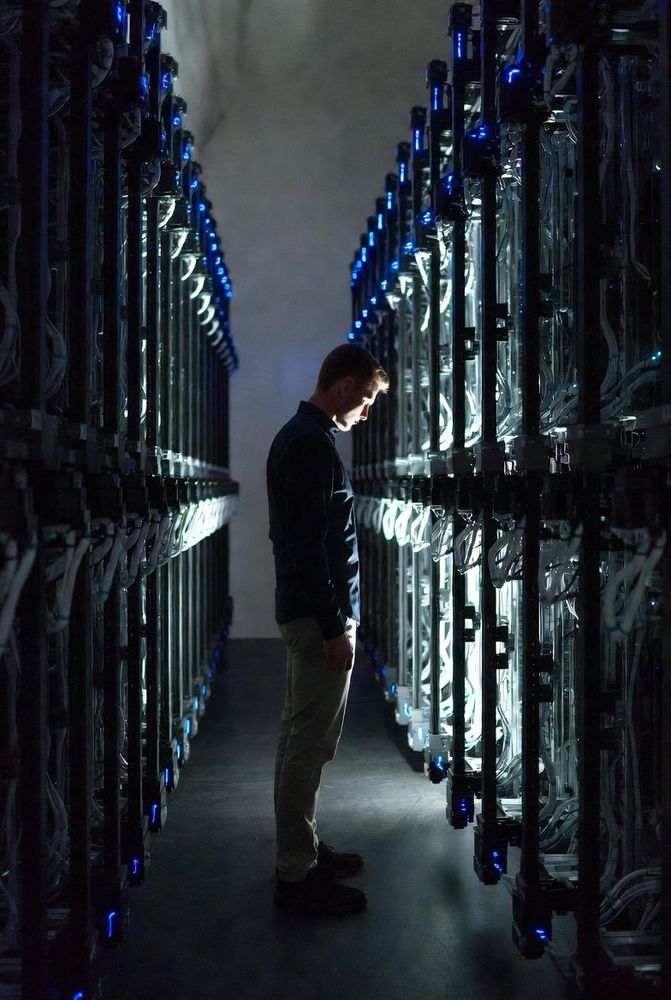
At the 2026 OCP Global Summit, Meta described a new network platform for its largest AI clusters: IceCube, a 102.4 Tbps switch blade, and IcePack, the liquid-cooled rack that holds it. Switch capacity is the headline number. For connector engineers the more interesting part is the rack, because moving a network switch from air cooling to liquid cooling puts coolant couplings, high-density ports and power contacts into the same small space.
This article separates what Meta has published from our own engineering analysis, and it lists what has not been disclosed yet.
In short:
- IceCube is a 102.4 Tbps fabric switch blade (128 ports of 800G, non-blocking), and IcePack is Meta's first-generation liquid-cooled network rack built on the OCP ORV3-HPRv1 standard.
- Meta has not published port form factors, optics, power figures, cooling specifications or a deployment date.
- The open ORv3 blind-mate manifold specification gives a good picture of the liquid interface that racks like this build on, but Meta has not said that IcePack uses it.
What Meta Has Confirmed
Meta's engineering post from the summit describes the platform as follows:
- IcePack: "Meta's first-generation liquid-cooled network rack," designed for high power density and better thermal efficiency. It is based on the OCP ORV3-HPRv1 rack standard and is populated with IceCube switch blades.
- IceCube: a 102.4 Tbps switch blade with 128 ports of 800G and non-blocking capacity. Meta calls it a 2x bandwidth increase over its 51.2T platforms.
- Switch silicon: two variants, one using Broadcom Tomahawk6C and one using NVIDIA Spectrum-6. The trade press has referred to the Spectrum-6 version as N-IceCube, a name Meta's own post does not use.
- Software: Meta's open-source FBOSS network operating system, using the OCP Switch Abstraction Interface (SAI).
Related announcements describe an eight-plane network fabric in which each GPU connects through eight independent 100G links, one to each of eight separate switches, and a two-tier Clos topology in place of three tiers. Meta also joined Microsoft and Alibaba in developing OSPA, an open switch platform architecture whose platform-management requirements include leak detection, autonomous power sequencing and redundant firmware images. OSPA revision 1.0.0 was still a candidate under OCP review at the time of writing.
What Has Not Been Disclosed
- Port and optics details: Meta has not said which module form factor the 128 ports use, or what optics, cables or reaches are involved.
- Power and cooling figures: blade power, rack power, coolant type, flow rates and temperatures are unpublished.
- Rack layout: the number of IceCube blades per IcePack and the blade dimensions have not been given.
- Coupling hardware: Meta has not published which quick-disconnect or electrical contact hardware IcePack uses.
- Open hardware status: it is not clear whether the IceCube and IcePack designs are being contributed to OCP.
- Availability: no shipping or deployment date has been given.
Some earlier write-ups of IcePack mention a blind-mate optical backplane. We could not find that in Meta's published material, so we do not treat it as confirmed.
The Liquid Interface Racks Like This Build On
IcePack follows ORV3-HPRv1, and ORv3 already has an open blind-mate liquid cooling interface. The OCP ORv3 Blind Mate Manifold Specification (Revision 1.0, April 2024 review version) describes it:
- Blind-mate quick connector (BMQC): a dripless coupling with the socket on the rack manifold and the plug on the rear of the IT equipment, so a technician does not connect hoses by hand when sliding gear in.
- Manifold limits: the manifold may deflect no more than 1.0 mm in the depth direction, with a maximum working pressure of 50 psig and a maximum fluid temperature of 60°C.
- Reference design: 24 valves, 12 on each side of the cross-brace, with manifold ports threaded 3/4-16 UNF-2B.
- Flow balance: the specification recommends flow distribution within 5% between branches, and notes that its reference design measured about 10% in testing.
- Where the float numbers live: the allowable misalignment and float range of the coupling itself are defined in the separate BMQC specification, not in the manifold document.
Meta has not said that IcePack uses this exact hardware, so read this section as the open standard that ORv3-based liquid racks are designed around, not as IcePack's own specification.
Our Analysis: Connector Questions for a Liquid-Cooled Switch
The points below are our engineering assessment of this kind of platform, not published Meta data.
1. Two blind-mate systems on one rear face
A switch blade in a liquid-cooled rack typically has to engage a coolant coupling and electrical power contacts at the rear in a single insertion. Fluid couplings and electrical contacts have different insertion forces and different tolerance needs, so designers usually separate the jobs: coarse guide features position the blade, and each connector then floats to absorb the remaining misalignment. Because the manifold itself is allowed up to 1.0 mm of deflection, the couplings have to tolerate that movement as well as normal chassis tolerance. Our UQD and UQDB guide summarizes the OCP coupling specification, and our NVIDIA MGX 1.2 article covers another blind-mate liquid-cooled rack.
2. Port density on the faceplate
128 ports of 800G on one blade is a very dense faceplate. At 800G, a port normally carries eight 100G lanes or four 200G lanes, so the blade has on the order of a thousand high-speed electrical lanes reaching the optics. Whatever module type Meta chose, the cage, connector and thermal design around it is a major part of the blade. For background on how those module interfaces behave, see our guide to OSFP and QSFP signal integrity at 800G and 1.6T. For a related look at where optics are heading, see USFP and co-packaged optics. Meta has not tied IceCube to either.
3. Leakage and serviceability
OSPA lists leak detection among the platform functions, which fits the main practical worry with liquid in a network rack: any coupling that can drip is next to equipment that cannot tolerate it. This is why drip-free couplings, drain paths and leak sensing are part of the specification work, and why serviceability matters as much as thermal performance.
4. Power delivery
ORV3-HPRv1 racks distribute power on a vertical busbar. Our guide to Open Rack busbar power connectors covers the contact design behind that, and our ORv3 compliance checklist lists what a connector has to demonstrate to be called ORv3 compatible. For a compute rack with the same kind of power and cooling questions, see AMD Helion: what it means for connectors, and for where rack power distribution may be heading, see 800 VDC.
More coverage is in our OCP server interconnects hub.
Last updated October 14, 2026. We will update this article if Meta publishes IceCube or IcePack hardware specifications to OCP.