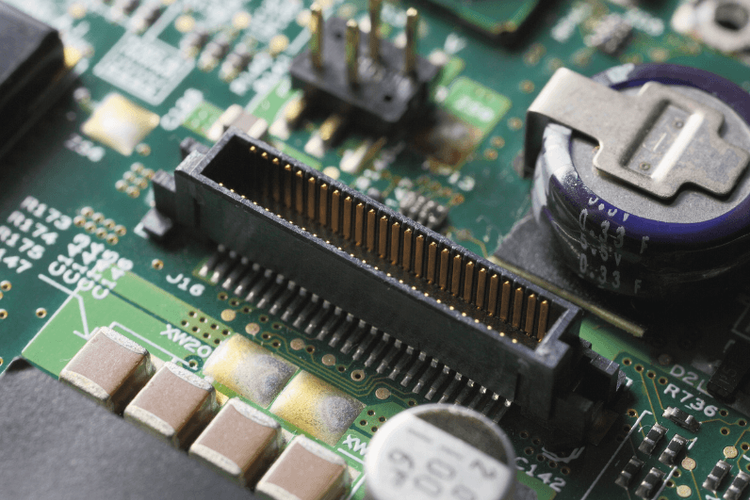
In industrial IoT and robotics applications, a loose flexible printed circuit (FPC) connection is more than an inconvenience — it's a failure point that takes down the whole system. Hardware mounted on a high-speed robotic arm, or exposed to the thermal expansion cycles of an outdoor base station, experiences constant micro-movement that a simple friction-fit connector was never designed to survive. These environments call for active mechanical retention, and two mechanisms dominate this space: Autolock and Backlock. They solve the same underlying problem through genuinely different physics, and the right choice depends on your specific constraints.
Autolock: Positive Mechanical Engagement
Autolock connectors, pioneered by vendors like I-PEX and Hirose, work by physically hooking the cable rather than merely clamping it. The FPC itself is manufactured with notched "ears" along its edges. When the cable is pushed into the connector, spring-loaded metal locks snap into these notches, producing both an audible and tactile click on insertion — a detail that matters more than it might seem, since it gives a technician immediate confirmation of a correct connection during manual assembly, without needing a continuity check.
The real engineering payoff is in pull-out force. Because the cable is mechanically hooked rather than just gripped, you cannot pull an Autolock cable free by tugging on the wire — the physical release buttons on the connector body have to be deliberately depressed first. That makes Autolock the standard choice anywhere sustained or shock-level G-forces are a real risk: drone flight controllers, engine-mounted sensors, or any application where vibration alone might otherwise work a friction-fit cable loose over time.
Backlock: Using Cable Tension Against Itself
Backlock (sometimes called Rotary Backlock) takes a different approach, and it's worth understanding the actual mechanics rather than treating it as a simple variant. In a standard front-flip actuator, pulling on the cable puts stress directly on the hinge — the opposite of what you want. In a Backlock design, the actuator hinge sits at the rear of the connector instead of the front. This geometry means that pulling on the cable doesn't work the hinge loose — it forces the cam mechanism *tighter* against the FPC. The tension in the cable is converted directly into additional normal force at the contacts, rather than being an adversarial force trying to separate them.
This rear-actuator geometry has a second, less obvious benefit: because there's no actuator mechanism occupying the front of the housing, the connector's throat can be built to tighter dimensional tolerances. Tighter tolerances at the mating interface make it meaningfully harder for dust and moisture to penetrate to the contact area — which is exactly why Backlock has become the preferred architecture for high-density industrial sensors that need to combine retention, density, and environmental sealing in the same compact footprint.
Choosing Between Them
The decision usually comes down to available board space and the dominant failure mode you're protecting against. If your primary risk is a technician or a passing cable snagging and pulling the connector loose — Autolock's positive mechanical hook, with its deliberate two-step release, is the more foolproof choice. If your primary risk is sustained vibration or thermal cycling working a connection loose over months or years, and you don't have room for actuator buttons at the front of the housing, Backlock's self-tightening geometry and superior sealing potential make it the better fit.
Both mechanisms exist precisely because the automotive and industrial environments they're built for don't tolerate the same "friction is good enough" assumption that consumer electronics can get away with — a design consideration explored in more depth in our 0.80mm pitch floating connector guide for automotive cockpit electronics, which covers the same vibration-driven retention problem from a board-to-board connector's perspective rather than a flex-cable one.