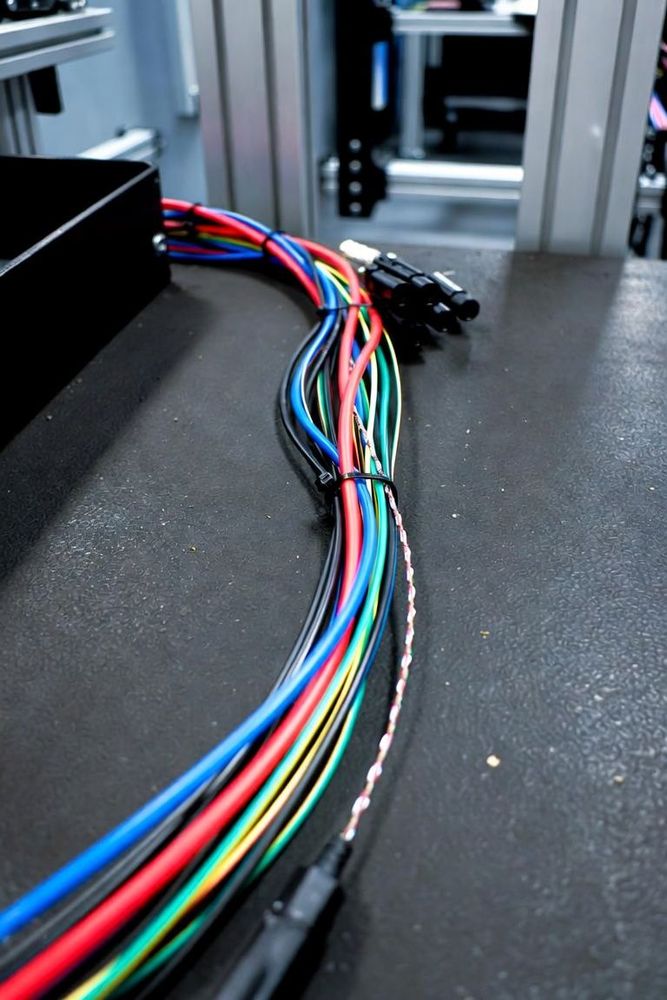
Managing Wiring Complexity
A modern wiring harness is a complex, sprawling network that bundles thousands of individual conductors, terminals, and connectors into a unified distribution system. In advanced industrial systems or automotive architectures, managing this complexity requires moving beyond simple point-to-point routing logic. Harness engineers must optimize bundle topologies, handle mechanical layout stresses like bend radii, and implement rigorous automated testing protocols.
Bundle Architecture and Layout Constraints
Individual wires are routed along shared pathways, grouped, and bound together using plastic cable ties, expandable braided sleeving, or heavy-duty split-conduit tubing. Bundling provides vital mechanical advantages, protecting individual lines from abrasion against sharp metal frames and turning loose wires into a self-supporting structural unit.
However, packing multiple active conductors into a tight bundle introduces serious thermal and electrical constraints:
- Thermal Derating: When multiple power-carrying lines are tightly bound, their combined heat output is trapped within the bundle core, driving up local temperatures and requiring engineers to apply strict current derating factors to prevent insulation melting.
- Minimum Bend Radius: Copper strands and plastic insulation jackets suffer from material fatigue if bent too sharply. Engineers calculate a strict minimum bend radius, typically set to 6x to 10x the overall outside diameter of the finished bundle. Bending past this limit strains the outer wire layers, deforms internal contacts, and can trigger wire fractures or micro-shorts under vibration.
Automated Continuity Testing
Once a harness is physically assembled, it must pass through advanced, automated testing blocks to guarantee 100% circuit integrity. The first phase is automated Continuity Testing, where a low-voltage test signal maps the wiring network to ensure every pin on Connector A reaches its exact destination on Connector B. This phase instantly flags open circuits, broken conductors, and mispinned terminals where a technician accidentally swapped two lines in a multi-position housing.
High-Pot Insulation Testing
Following continuity, the assembly undergoes high-stress validation via Insulation Resistance Testing and Dielectric Withstanding Voltage Testing (High-Pot). During high-pot testing, a massive voltage—frequently exceeding 500V to 1500V DC—is applied between adjacent isolated conductive circuits and between the wire conductors and the outer shielding frames.
This test forces a high electrical stress field across the system, checking the insulation for microscopic pinholes, cracked jackets, or trapped conductive dust particles. If the leakage current climbs past a strict micro-ampere threshold, the tester flags an insulation failure, stopping a latent short circuit from making it into the field.
Verification as a Design Discipline
Wire harness engineering demands a careful balance between clean physical bundle management and rigorous electrical verification. By protecting cables from structural strain with precise bend radius limits, managing internal bundle heat, and validating every assembly with automated low-voltage continuity and high-voltage high-pot testing, engineers turn complex wiring layouts into highly reliable distribution networks.