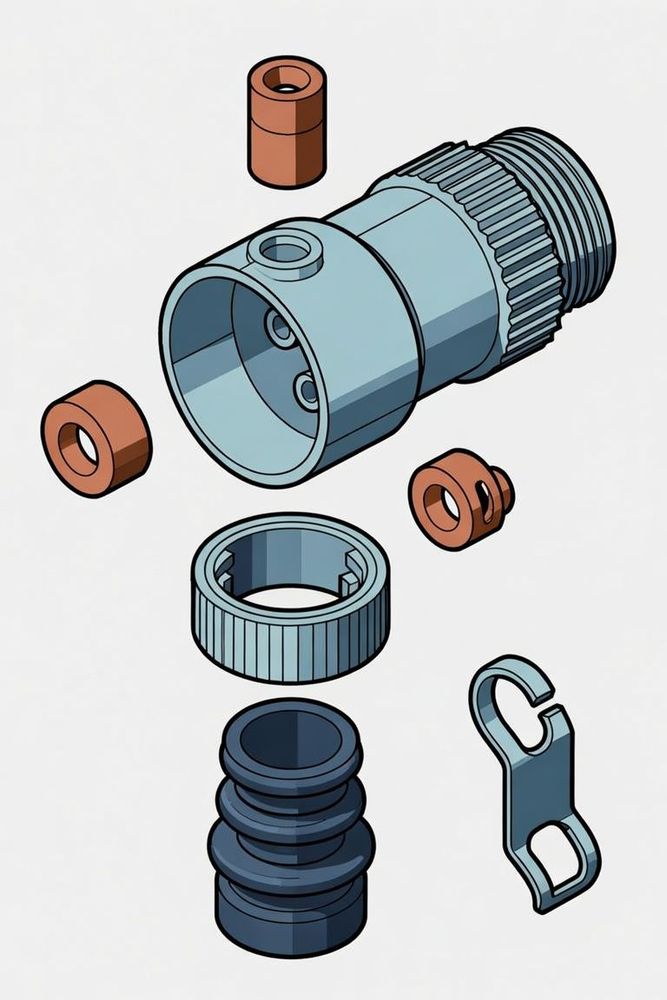
The Anatomy of an Interconnect
An electrical connector is a highly engineered assembly built from several interacting sub-components. Each element serves a specific purpose in maintaining electrical integrity, structural rigidity, and ease of use. Understanding these components helps designers diagnose failures and choose the right parts for demanding applications.
1. The Housing (Insulator / Dielectric)
The housing forms the exterior body of the connector. It acts as the mechanical foundation and electrical insulator for the assembly.
- Dielectric Isolation: It separates conductive paths from one another, ensuring current travels strictly along the intended channels.
- Polarization and Keying: Many housings include asymmetrical shapes, tabs, or slots that prevent mis-mating. Polarization ensures a connector can only be inserted in the correct orientation (preventing upside-down insertion), while Keying uses unique physical patterns to ensure that two identical-looking connectors carrying completely different signals cannot be cross-plugged into the wrong port.
- Circuit Identification: Housings often feature molded-in numbers or letters alongside each cavity to identify circuit paths during wiring and troubleshooting.
2. Contacts (Terminals)
The contacts are the internal metal components that establish the actual electrical bridge. They are divided into two distinct zones:
The Mating Interface
This is the area where the male pin meets the female socket. The engineering of this zone determines the insertion force (how hard it is to push the connector together) and the contact pressure (the force keeping the metal faces pressed against each other). High contact pressure lowers contact resistance but increases wear on the plating, reducing the connector's overall lifecycle.
The Termination Zone
This is the back end of the contact where it permanently bonds to a wire or a printed circuit board trace. There are several common termination methods:
- Crimp Terminals: The metal contact is mechanically crushed around a stripped wire end using a specialized crimping tool. This creates a cold-welded, highly reliable bond optimized for automated production.
- Solder Cups: Small, hollow metal cylinders that accept a stripped wire, which is then secured with melted solder. Excellent for prototyping and low-volume custom cable assemblies.
- PCB Pins: Rigid metal legs that extend through-board or rest on surface-mount (SMT) pads to be reflow-soldered directly to a circuit board.
- Insulation Displacement (IDC): The contact features sharp V-shaped blades that cut through a wire's plastic insulation to grip the underlying copper conductor directly, eliminating the need to strip wires beforehand.
3. Retention and Locking Mechanisms
To prevent connectors from shaking loose under mechanical stress or vibration, they often utilize active or passive locking mechanisms:
- Friction Fits: Rely purely on the mechanical interference and tightness between the housing walls and contacts. Common in low-vibration environments like desktop computer internals.
- Positive Locking Latches: Feature a spring-loaded plastic or metal arm that clicks into a matching recess on the mating connector. It cannot be separated without physically depressing the latch lever (e.g., RJ45 Ethernet clips).
- Bayonet and Threaded Couplings: Common in circular aviation and RF connectors (like BNC or SMA). The user pushes and twists an outer ring to lock the assembly firmly in place, providing high security in high-vibration environments.
4. Strain Relief and Booting
The junction where a flexible cable meets a rigid connector housing is highly susceptible to fatigue from bending and pulling.
- Strain Relief: A mechanical clamp or molded rubber boot that grips the outer jacket of the cable. It transfers tensile forces away from the delicate internal electrical terminations and distributes the bending radius across a wider area, preventing wire breakage.
- Overmolding: High-volume consumer cables (like USB cords) inject liquid plastic directly over the soldered joint and cable end, creating a single, unbroken, highly durable piece.