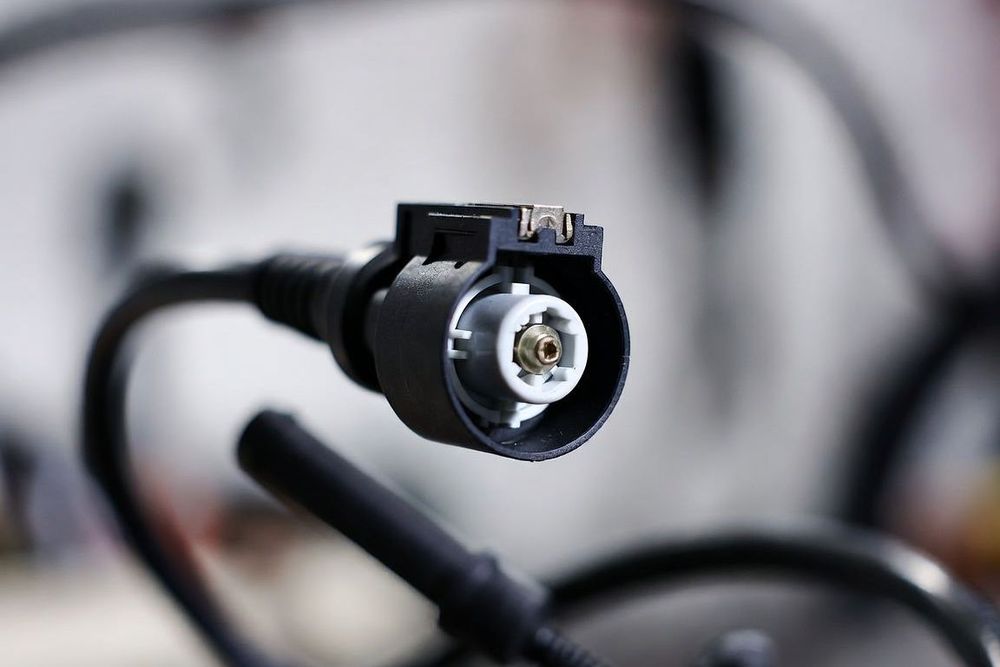
The Miniaturization Bottleneck in Automotive RF Systems
Standard FAKRA connectors have served as the automotive industry's workhorse for 50Ω radio-frequency (RF) signals for decades. However, the rapid proliferation of Advanced Driver Assistance Systems (ADAS), high-resolution 4K video feeds, 5G cellular telematics, and multi-sensor fusion modules has created a severe space bottleneck on Electronic Control Unit (ECU) front panels.
A conventional single-port FAKRA connector occupies a large physical footprint, limiting the number of coaxial interfaces that can be placed along a PCB edge. Mini-FAKRA—also known by manufacturer designations such as High-Speed FAKRA Mini (HFM)—was engineered specifically to solve this density crisis while extending RF performance well into microwave frequencies.
Key Differences: Physical, Mechanical, and Electrical
While both architectures share a nominal 50Ω characteristic impedance and use color-coded mechanical keying, their physical geometries and electrical capabilities diverge significantly:
1. Spatial Density and Footprint
Standard FAKRA: Uses a relatively large single coaxial contact housed inside an individual plastic shell. A single FAKRA port requires significant height (approx. 24mm) and width on the PCB.
Mini-FAKRA: Delivers up to an 80% space reduction compared to standard FAKRA. Rather than individual single-port housings, Mini-FAKRA is available in ganged multi-port modules (1-port, 2-port, 4-port, and quad-row arrays), allowing up to four RF channels in the PCB footprint previously occupied by a single standard FAKRA housing.
2. Operating Frequency and Data Throughput
Standard FAKRA: Optimized for traditional RF applications operating from DC up to 6 GHz, supporting maximum data transmission rates around 8 Gbps.
Mini-FAKRA: Engineered with a scaled-down internal contact geometry that extends signal integrity from DC up to 20 GHz (with bandwidths up to 28 Gbps). This extra frequency headroom is required for raw high-resolution video streams from uncompressed 4K surround-view cameras and millimeter-wave radar modules.
3. Mating Mechanics and Intermateability
Standard FAKRA: Features a prominent top-mounted plastic latch lever.
Mini-FAKRA: Utilizes an integrated internal latching mechanism with high retention force, optimized for automated robotic cable insertion during harness manufacturing.
Intermateability: Standard FAKRA and Mini-FAKRA are mechanically incompatible and cannot be mated directly together. Interfacing the two systems requires specialized hybrid adapter cables.
Hardware Design and Selection Rules
When choosing between standard FAKRA and Mini-FAKRA for automotive hardware layout:
- Specify Standard FAKRA for Legacy & External Antennas: Use standard FAKRA for basic single-ended RF lines, such as legacy AM/FM radio, GPS/GNSS receivers, satellite radio (SDARS), and entry-level LTE antennas.
- Specify Mini-FAKRA for Multi-Camera & High-Bandwidth ADAS: Use Mini-FAKRA multi-port ganged connectors when routing multiple high-speed Serializer/Deserializer (SerDes) video channels into a central ADAS domain controller.
- Enforce Tight Coplanar Launch Layouts on PCB: Because Mini-FAKRA handles frequencies up to 20 GHz, the PCB transition launch from the connector pin to the transmission line is extremely sensitive. Hardware engineers must run 3D electromagnetic field simulations to optimize ground-via fencing around the surface-mount launch pads to prevent VSWR degradation.