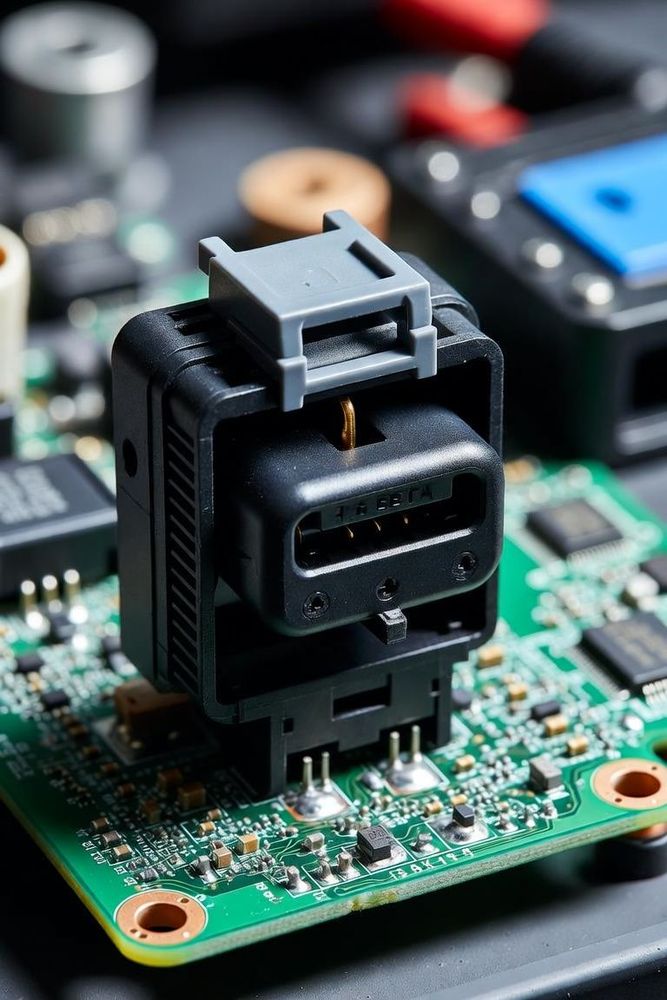
The Autonomous Vehicle Data Explosion
As autonomous driving platforms scale up functionality, the volume of high-speed sensor data flooding the vehicle's central computer is expanding exponentially. High-resolution 4K radar modules, LiDAR arrays, and ultra-fast serialization lines require massive high-frequency pipelines. While standard FAKRA connectors have served the automotive industry well for decades, their large physical footprint creates a major layout bottleneck on modern compact domain controllers. To pack more high-speed lines into shrinking module housings, automotive hardware designers are migrating to Mini-FAKRA connectors, also known as High-Speed FAKRA Mini (HFM). This interface scales data limits up to 20 GHz while slashing spatial volume requirements by up to 80%.
Multi-Port Packaging Density
The primary architectural advantage of Mini-FAKRA is its extreme packaging density. Traditional FAKRA layouts require a dedicated, bulky plastic housing for every single coaxial line. Mini-FAKRA overhauls this form factor by utilizing a modular, multi-port design configuration. A single Mini-FAKRA housing block can cleanly package four independent RF channels into the exact same spatial envelope previously consumed by a single standard FAKRA connector. This ultra-dense arrangement allows layout engineers to maximize panel real estate on the server blade or ECU, routing multiple high-speed camera feeds straight into a highly compact, multi-port SMT header.
20 GHz Transmission Line Requirements
Electrically, the transition from 4 GHz standard FAKRA to 20 GHz Mini-FAKRA requires a significant upgrade in transmission line physics. The internal coaxial inserts are shrunken down to a microscopic scale, utilizing highly precise impedance-controlled stamped contacts wrapped in advanced low-loss dielectrics. At 20 GHz, the wavelengths are short enough that even a minor sub-millimeter manufacturing tolerance error inside the connector will trigger severe impedance spikes and catastrophic insertion losses.
Mini-FAKRA interfaces control these anomalies by enforcing tight manufacturing coplanarity tolerances across the SMT solder tails, keeping the internal path locked at a flat 50 Ohm differential profile to enable the transmission of uncompressed real-time telemetry.
Retained Automotive Ruggedness
Despite this drastic reduction in size, Mini-FAKRA connectors fully retain the strict mechanical ruggedness required for automotive applications. The modular plastic blocks utilize an optimized color-coding system and mechanical keying tracks to prevent mismatch errors during assembly. A robust primary latching mechanism, coupled with a secondary CPA (Connector Position Assurance) lock, ensures that the multi-port interface cannot be jarred open by rough road shock or engine bay harmonics.
The Future of Automotive RF
By balancing extreme packaging density, 20 GHz bandwidth capabilities, and tough mechanical latching, Mini-FAKRA represents the premier interconnect foundation for next-generation autonomous vehicle telemetry networks.