Eliminating the Wire-Stripping Bottleneck
In high-volume electronic assembly, processing individual wire leads is a major manufacturing bottleneck. Stripping insulation, feeding wires into crimp barrels, and inspecting individual terminal crimps requires significant time and automation overhead. When a design calls for multi-conductor, parallel wire-to-board routing—such as bus communication lines, display linkages, or modular control panels—engineers turn to Insulation Displacement Contact (IDC) connectors. Invented to maximize factory throughput, IDC technology eliminates the wire-stripping phase entirely.
The Mechanics of the IDC Slot
The core of an IDC system is an elastic, dual-tine metal slot, typically stamped from high-strength phosphor bronze or beryllium copper. The internal geometry of this slot is engineered with a continuous taper that narrows down to a width slightly smaller than the diameter of the internal copper conductor core.
When the insulated wire is driven downward into the slot via a flat-rock press tool, the sharp, chamfered upper entry edges of the metal tines slice through the plastic insulation (PVC, Teflon, etc.) on opposite sides of the wire. As the bare copper conductor slides deeper into the narrow slot, the intense friction scrapes away native copper oxides, exposing a pristine, un-oxidized metallic surface. The conductor forces the two metal tines outward, causing them to flex within their elastic limits. The tines act as continuous cantilever springs, applying a permanent residual normal force against the copper core.
Long-Term Material Challenges
Because an IDC joint relies on continuous spring pressure rather than a permanent cold weld or solder fillet, it faces unique long-term material physics challenges:
- Cold Flow: When the insulation layer is sliced open, the surrounding plastic elastomer experiences massive localized pressure. Over time, plastics tend to creep away from areas of high stress. IDC housings must be engineered with internal plastic containment chambers that prevent the displaced insulation from pressing backward against the metal tines, which could otherwise weaken the contact's elastic grip.
- Stress Relaxation: At elevated operating temperatures, all copper alloys experience stress relaxation — a phenomenon where the internal spring tension decays over time, dropping the contact normal force. High-tier IDC contacts are designed to operate well within their elastic limit. Manufacturers utilize phosphor bronze for standard thermal ranges, stepping up to beryllium copper for harsh environments.
Implementation Topologies
IDC wire-to-board layouts are broadly split into two implementation topologies:
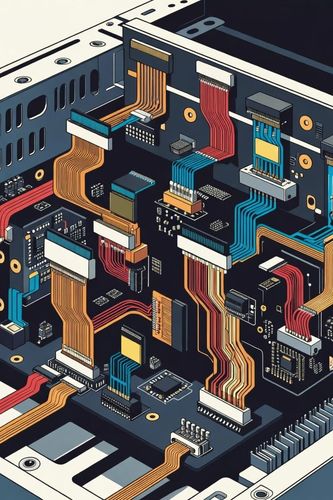
- Flat Ribbon Cables: The classic ribbon application uses a flat cable where multiple parallel conductors are bonded together in a single planar jacket. A multi-position IDC connector can terminate 10, 40, or 64 positions simultaneously in a single press operation, completely bypassing individual wire routing and dramatically driving down factory assembly costs.
- Discrete Wire IDCs: Modern miniaturized W2B platforms allow discrete, single-strand wires to be stuffed into individual IDC slots populated straight onto the PCB surface. These micro-IDC terminal blocks are heavily used in automated smart lighting and sensor blocks, where a field technician can insert a wire and lock it down using a simple hand tool without needing specialized crimping equipment.
High-Throughput Termination
Insulation Displacement Contact connectors deliver high-speed manufacturing efficiency by combining insulation stripping, oxide removal, and gas-tight spring gripping into a single automated step. Successfully utilizing IDCs requires a strict match between the specific wire gauge (AWG), wire type (solid vs. highly stranded), and the connector slot dimension. When properly balanced, IDC joints offer an exceptionally clean, low-resistance interface that slashes processing time while maintaining long-term electrical stability.