The Universal Interface
The USB Type-C interface represents one of the most significant overhauls in consumer and industrial I/O history. Moving far beyond the passive, single-purpose design of legacy USB ports, the modern USB-C connector acts as a unified hub capable of simultaneously routing multi-gigabit data protocols (such as USB4, Thunderbolt 4/5, and DisplayPort), alongside massive power distribution profiles. Operating this dense, highly versatile interface requires managing a compact 24-pin flippable layout, handling strict high-frequency signal integrity constraints, and controlling the intense thermal dissipation generated by high-wattage power transmission.
Reversible 24-Pin Architecture and CC Negotiation
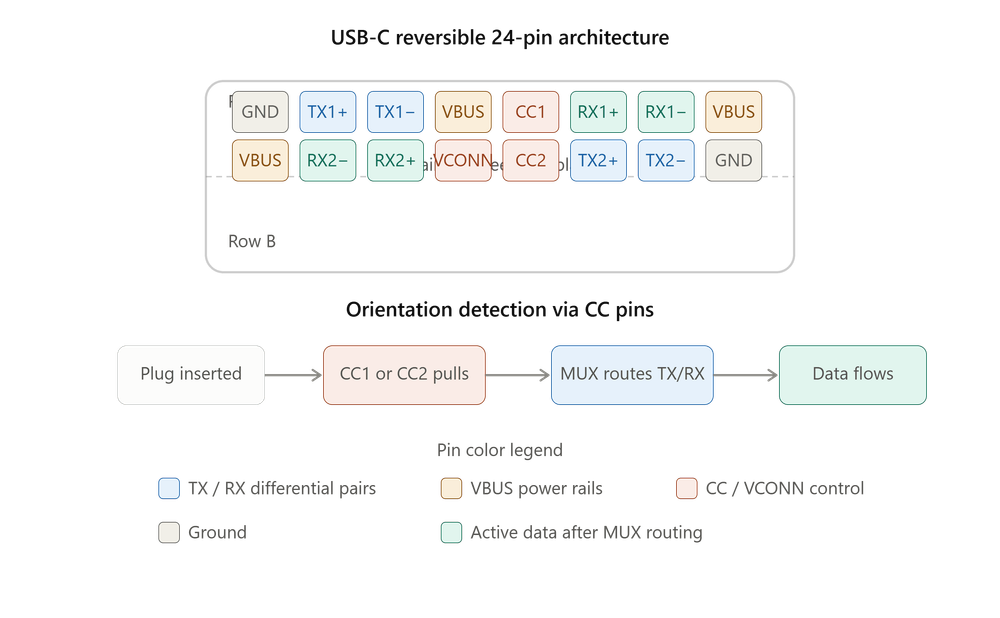
The defining feature of the USB-C connector is its complete physical reversibility. A user can plug the cable in right-side up or upside down, and the system adjusts instantly. Achieving this requires a symmetrical 24-pin matrix split across two identical rows, designated as side A and side B.
The connector relies on dual Configuration Channel (CC1 and CC2) pins to act as the primary intelligence layer. When a plug enters the receptacle, the orientation is determined by sensing which CC pin establishes a pull-up or pull-down resistance network. Once orientation is locked, internal multiplexers dynamically route the high-speed TX and RX differential pairs to align perfectly with the cable's active lines, enabling seamless data rates up to 40 Gbps and 80 Gbps without requiring precise manual alignment.
240W EPR Thermal Management
Simultaneously managing high-wattage power routing within this tight 0.50 mm pitch pin field introduces serious thermodynamic and insulation constraints. Under the Extended Power Range (EPR) specification, USB-C interfaces can deliver up to 48V at 5A, pushing a massive 240 Watts of power through a single interface. At these scales, any slight contamination or moisture ingress within the pin field can cause destructive localized electrical arcing or rapid Joule heating.
To prevent thermal runaway, high-tier USB-C receptacles are engineered with specialized high-conductivity copper alloy terminals (such as beryllium copper) wrapped in high-temperature liquid crystal polymers. Additionally, the internal CC and VBUS lines use integrated thermal sensing loops that communicate directly with the Power Delivery (PD) controller, instantly throttling the current if the connector temperature crosses a strict 85°C safety ceiling.
EMI Shielding Architecture
Signal preservation is further complicated by the extreme density of the connector shell. Because the high-speed differential lines run directly alongside high-voltage VBUS pins and high-frequency clock lines, the interface is highly vulnerable to internal near-end crosstalk and external electromagnetic radiation.
To contain these fields, USB-C connectors deploy a deep internal metal shielding matrix. A stamped stainless steel mid-plate runs horizontally through the center of the plug, isolating row A from row B. The outer shell features full-perimeter grounding fingers that snap firmly into the receptacle cage, establishing an unbroken 360-degree Faraday cage that suppresses EMI and protects nearby wireless radios from high-frequency signal noise.
Balancing Data, Power, and Protection
USB-C interconnects provide the ultimate combination of high-density data and robust power delivery. Successfully implementing this universal interface requires a thorough understanding of dynamic orientation multiplexing, precise thermal mitigation protocols to safely distribute hundreds of watts of power, and strict internal mid-plate shielding to prevent destructive cross-coupling. When these electrical, thermal, and mechanical safety layers are fully balanced, USB-C delivers stable, high-performance connectivity across the modern electronic landscape.