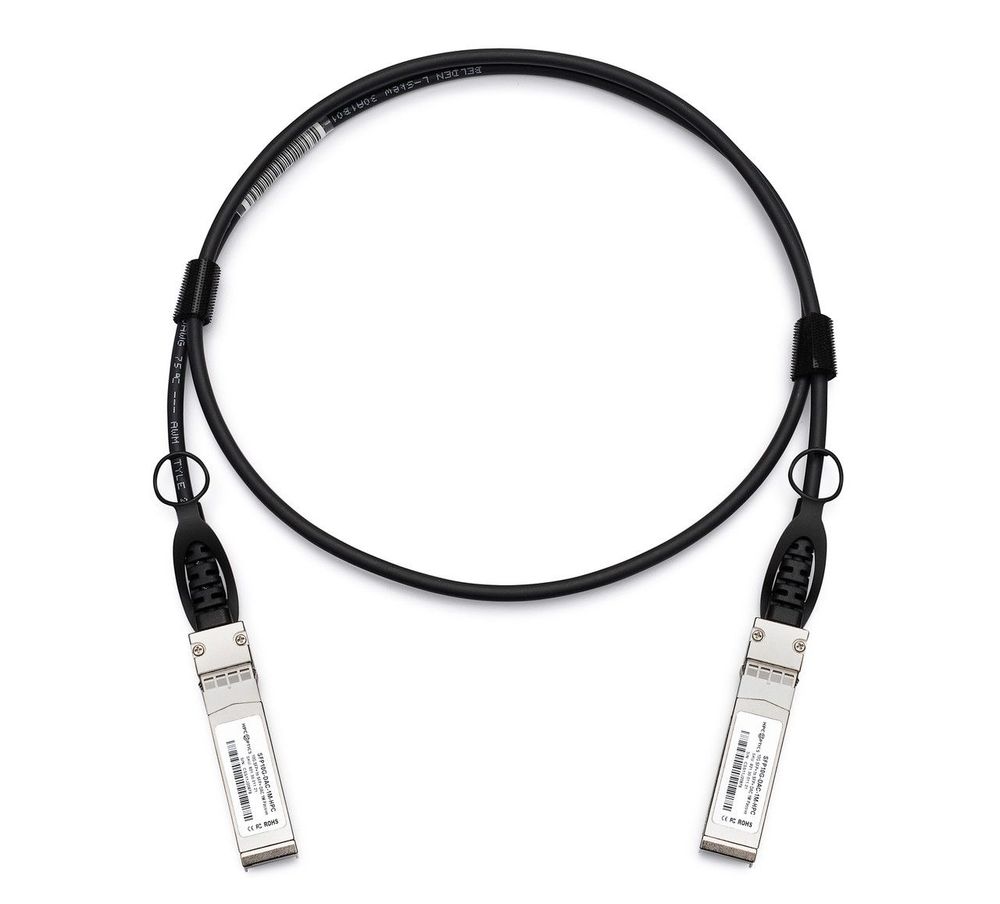
The Sweet Spot of Short-Reach Connectivity
When high-speed data needs to travel across a server rack, traditional copper twisted-pair cables fall short due to excessive attenuation and electromagnetic leakage. Optical fiber links solve this distance challenge but introduce significant cost and power consumption overhead. For short-reach connections spanning 1 to 5 meters, Direct Attach Cable (DAC) assemblies built from high-performance twinaxial (twinax) cable provide the ultimate sweet spot — a low-cost, ultra-low-latency, zero-power physical data pipeline.
Twinaxial Cable Construction
The unmatched performance of twinax cables stems from their precise, shielded geometric construction. Unlike a standard coaxial cable that runs a single center conductor inside a shield, a twinaxial cable features two parallel, solid-core copper conductors embedded within a single continuous shield. The dual conductors run as a tightly coupled differential pair. The outer shield, typically formed from wrapped aluminized polyester foil or tight silver-plated copper braiding, forms an impenetrable Faraday cage that blocks external electromagnetic noise while trapping high-frequency radiation inside the wire jacket.
Intra-Pair Skew — The Critical Failure Mode
To preserve signal integrity at data rates like 112 Gbps PAM4, twinax manufacturing requires absolute geometric uniformity. The single most destructive distortion mechanism in high-speed differential cables is intra-pair skew. If one conductor is even a fraction of a millimeter longer than its twin, or if the surrounding dielectric material varies in thickness, the positive and negative signals will fall out of time alignment.
This delay converts a portion of the clean differential signal into a destructive common-mode signal, causing severe phase distortion and radiating electromagnetic interference. Manufacturers use automated precision-wrapping lines that apply uniform tension and utilize advanced foamed dielectrics to ensure a perfectly consistent dielectric constant along the entire cable length.
Passive vs. Active DAC Assemblies
At the cable ends, twinaxial wires are terminated directly onto miniature paddleboards housed inside hot-pluggable form-factor shells such as SFP, QSFP, or OSFP modules.
- Passive DAC: Does not include active signal-conditioning silicon. Relies entirely on the native quality of the copper channel. Lower cost, zero additional power consumption.
- Active Copper Cable (ACC): Embeds miniature linear equalizers or retimers inside the connector backshell. Boosts high-frequency components of the signal to fight copper skin losses, pushing twinaxial performance boundaries to their absolute physical limits.
Precision Construction for Low-Latency Links
Twinax DAC assemblies provide the optimal short-reach high-speed data pipeline for rack-scale deployments. Achieving their full performance potential requires absolute geometric cable uniformity, matched dielectric consistency, and precisely optimized paddleboard impedance transitions at each connector endpoint.