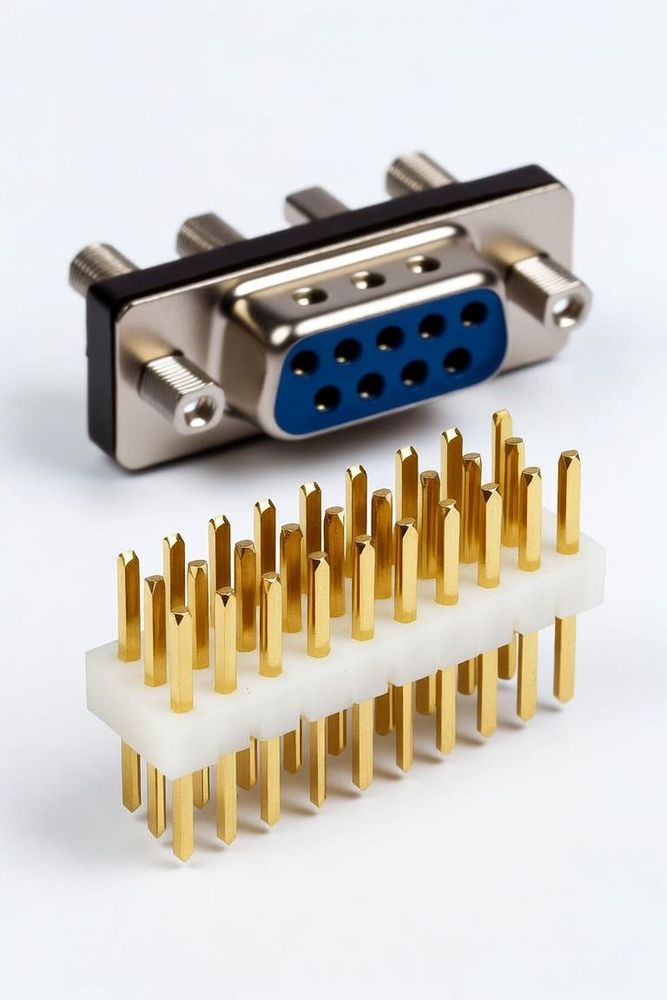
Defining Connector Gender
In electromechanical design, electrical connectors are assigned gender classifications based on their physical geometry and how they mate together. This terminology provides a universal framework for engineers, technicians, and manufacturers to specify how components pair.
The primary distinction centers on the mechanical nature of the conductive contacts inside the connector housing, rather than the exterior shape of the protective shell.
- Male Connector: Features one or more exposed conductive pins or prongs that project outward from the connector body.
- Female Connector: Features matching recessed sockets, slots, or receptacles designed to accept the insertion of the male pins, establishing a secure electrical and mechanical bond.
Terminology: Plugs, Jacks, Receptacles, and Headers
While "male" and "female" describe the internal contact types, other industry terms clarify how the connector is physically mounted or handled:
Plugs
A plug is typically the mobile or free-hanging end of a cable assembly. It is the component handled by the user to complete a circuit. While most plugs feature male contacts (such as a standard AC power cord plug), some plugs utilize female contacts (such as an extension cord end or an IEC C13 computer power cord).
Receptacles and Jacks
These are stationary connectors fixed to a panel, enclosure wall, or printed circuit board. A jack usually refers to a female interface designed to accept a mobile plug (such as a 3.5mm headphone jack or an RJ45 network port).
Headers
Commonly found on printed circuit boards, headers consist of arrays of pins (male) or sockets (female) soldered directly to the traces. They act as the physical landing pad for wire harnesses.
The Critical Safety Rule of Gender Assignment
The choice of which side of a circuit receives a male or female connector is rarely arbitrary. It is dictated by a fundamental safety axiom in electrical engineering:
The live, power-supplying side of an open circuit must always use a female connector.
Because the conductive elements of a female connector are recessed within an insulating housing, it is highly difficult for human fingers, loose tools, or stray metal objects to accidentally touch the energized contacts. This drastically minimizes the risk of catastrophic short circuits, equipment damage, and electrical shock.
Conversely, the exposed pins of a male connector are vulnerable to physical contact. If a male connector were used on a live power source, dropping a metal wrench across the exposed pins would create an immediate short circuit. Therefore, male connectors are strictly reserved for the load or dead side of the circuit—components that only carry voltage once they are safely plugged into the power source.
Examples in Daily Application
- Wall Outlets: The AC mains outlets in your home are female receptacles, keeping dangerous grid voltages buried safely behind plastic slots. The appliance cord uses a male plug because its prongs carry no voltage until inserted into the wall.
- USB Ports: A computer or wall charger acts as a power source, which is why it features a female USB Type-A or USB-C port. The peripheral device (mouse, keyboard, flash drive) uses a male plug.
Hermaphroditic and Genderless Connectors
While the male-female binary governs most interconnect designs, certain applications benefit from genderless architecture. Hermaphroditic connectors feature identical mating faces containing both male and female elements, or unique flat-wiping profiles. Any connector in a given family can mate with any other connector in that same family.
Anderson Powerpole Connectors
Widely used in amateur radio, electric vehicles, and backup power systems, these connectors use flat, spring-loaded silver-plated contacts. There are no distinct pins or sockets. This simplifies inventory management and field deployment, as users do not need to worry about sourcing matching pairs of opposite genders.
IBM Token Ring / Data Connectors
Legacy network setups utilized hermaphroditic blocks where the housings locked into one another when rotated 180 degrees, allowing cables to be easily chained together without extension couplers.