Ethernet Moves to the Factory Floor
Ethernet has expanded far beyond its traditional home in temperature-controlled office server rooms, cementing itself as the primary communication backbone for modern industrial automation, factory floor robotics, and heavy transportation transit networks. However, the standard plastic RJ45 patch cable found in a typical office setup is fundamentally unsuited for industrial deployment. The harsh realities of the factory floor—characterized by continuous mechanical vibration, intense electromagnetic noise from high-voltage motors, and exposure to corrosive fluids—will rapidly destroy a standard commercial connector.
Industrial-Grade RJ45 Upgrades
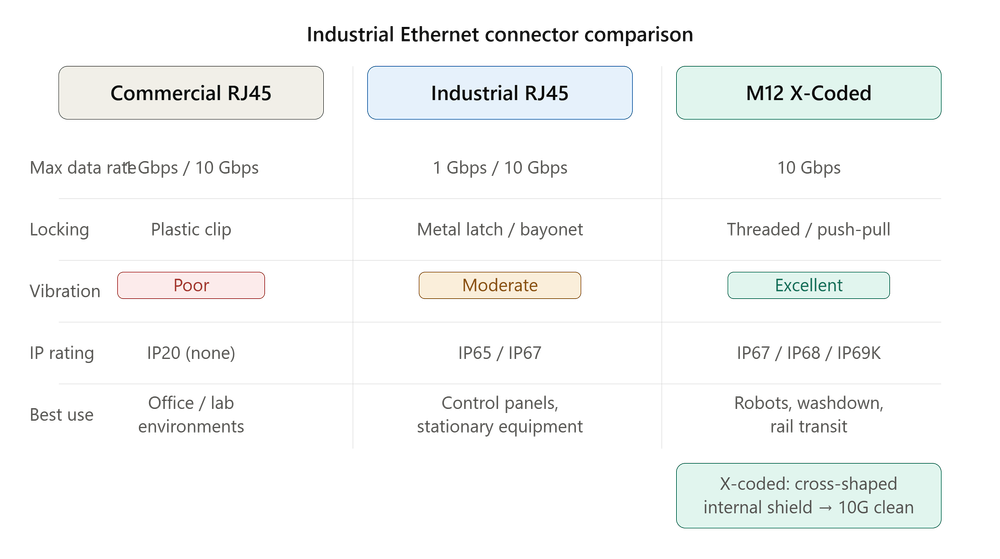
The first step in upgrading an Ethernet link for industrial duty involves overhauling the classic RJ45 interface. Standard commercial RJ45 jacks rely on a thin, flexible plastic locking tab that easily snaps off, leaving the connector vulnerable to sliding out under minimal tension.
Industrial-grade RJ45 connectors solve this mechanical weakness by encasing the entire plastic assembly inside a heavy-duty, die-cast zinc or glass-filled polymer outer shell. These industrial variants utilize robust dual metal locking latches or full twist-lock bayonet shrouds that mechanically lock the plug into the chassis port. This configuration easily resists pullout forces exceeding 100 Newtons while compressing heavy internal elastomeric gaskets to provide reliable IP65 or IP67 environmental sealing.
Migrating to Circular M12 Connectors
However, when a system is subjected to severe, multi-axis low-frequency vibration—such as an automated robotic welding arm or an onboard rail transit control box—even an industrial RJ45 can exhibit performance issues. The flat, spring-loaded finger contacts of an RJ45 can experience micro-disconnections, where the contacts momentarily separate for a few nanoseconds, causing catastrophic data packet loss.
To eliminate this vulnerability, harsh industrial applications migrate to circular M12 connectors. Stamped out of machined metal barrels featuring internal threaded or push-pull locking sleeves, M12 connectors utilize solid, round pin-and-socket contacts that completely eliminate micro-disconnections even under continuous harmonic shaking.
M12 Coding Standards
- D-Coded M12: Employs a 4-pin layout optimized for basic Fast Ethernet (100 Mbps) industrial fieldbus networks, offering exceptional mechanical durability over a minimal footprint.
- X-Coded M12: Incorporates an advanced 8-pin arrangement divided into four isolated quadrants by a cross-shaped internal metal shield. This specialized cross-shielding completely blocks internal crosstalk, allowing the connector to cleanly transmit full 10 Gbps Ethernet streams directly alongside high-voltage machinery.
Matching the Connector to the Environment
Industrial communication systems demand interconnect components that match the raw physical durability of the heavy machinery they govern. While upgraded, shielded industrial RJ45 housings provide an excellent, cost-effective path for stationary control panels, extreme dynamic applications require migrating to circular M12 architectures. By specifying X-coded cross-shielded configurations to preserve high-speed signal integrity and leveraging threaded locking mechanisms to absorb multi-axis vibration, engineers ensure that high-speed Ethernet streams remain perfectly stable throughout the operational lifespan of the factory floor.