Beyond DC Circuit Logic
In the high-speed digital regime, an electrical pulse traveling through a connector can no longer be evaluated using simple DC circuit logic. Modern data paths operate at high fundamental frequencies where copper conductors act as lossy transmission lines, and every geometric transition within a connector behaves as an impedance discontinuity. Validating these complex, multi-gigabit channels requires hardware designers to master advanced Signal Integrity (SI) physics — managing the shift from binary signaling to PAM4, mitigating inter-symbol interference, and using eye diagram analysis to verify system performance.
NRZ vs. PAM4 Signaling
The industry-wide transition from Non-Return-to-Zero (NRZ) signaling to Pulse Amplitude Modulation (PAM4) was driven by the severe frequency limitations of copper circuit boards. NRZ signaling utilizes two distinct voltage levels (0 and 1) to transmit 1 bit of data per clock cycle. As data rates pushed past 50 Gbps, the required operating frequency for NRZ caused extreme signal attenuation.
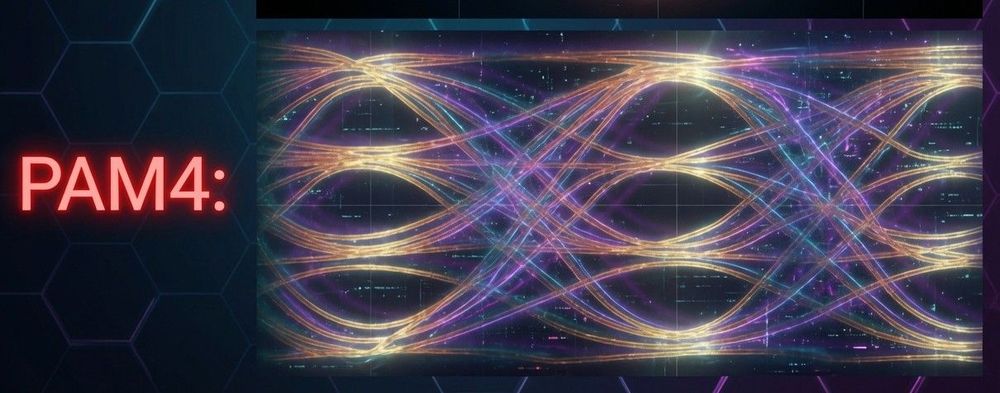
PAM4 resolves this bottleneck by using four distinct voltage levels (00, 01, 10, and 11) to compress 2 bits of data into the exact same time slice. This allows a 112 Gbps PAM4 stream to operate at a fundamental Nyquist frequency of 28 GHz, cutting channel attenuation in half compared to an NRZ layout running at the same speed.
The PAM4 Noise Sensitivity Trade-off
The bandwidth advantages of PAM4 come with a major trade-off in noise sensitivity. Because PAM4 divides the same maximum voltage window into three independent signal eyes, the physical height of each individual eye is reduced to just 33% of a standard NRZ eye. The Signal-to-Noise Ratio (SNR) drops by roughly 9.5 dB, making PAM4 channels highly vulnerable to corruption from minor noise sources, crosstalk, and Inter-Symbol Interference (ISI).
ISI occurs when high-frequency attenuation causes an electrical pulse to spread out in time, bleeding over into adjacent bit slots and distorting the surrounding signals. High-speed connector designs require extremely low residual crosstalk and flat insertion loss curves up past 30 GHz to prevent ISI from closing the delicate PAM4 windows.
Eye Diagram Analysis
To analyze and validate complex channels, engineers rely heavily on the Eye Diagram. An eye diagram is constructed by capturing a continuous, high-speed digital data stream and overlaying thousands of individual bit periods onto a single time window using a high-bandwidth oscilloscope. Analyzing this pattern allows engineers to immediately evaluate:
- Eye Height: Measures the remaining voltage margin; a wider open vertical space indicates robust noise immunity.
- Eye Width: Displays the remaining timing margin, showing how much jitter is present in the system.
- Jitter Breakdown: Reveals deterministic jitter (caused by predictable channel reflections and impedance drops in the connector pin field) and random jitter (triggered by thermal noise and clock oscillators).
If a connector introduces a sharp impedance discontinuity—such as an un-backdrilled via stub or an unshielded pin transition—the resulting signal reflections will cause the traces on the scope to blur and thicken, closing the eye pattern and leading to high Bit Error Rates (BER).
Eyes Wide Open
Modern high-speed design requires defining strict keep-out eye masks within the scope software. The signal traces must never cross into these designated boundary boxes. By analyzing eye closures, optimizing impedance paths across the connector pin field, and leveraging advanced digital equalization (such as CTLE and DFE), engineers can reliably pull clean, error-free PAM4 data streams through high-density interconnect frameworks.