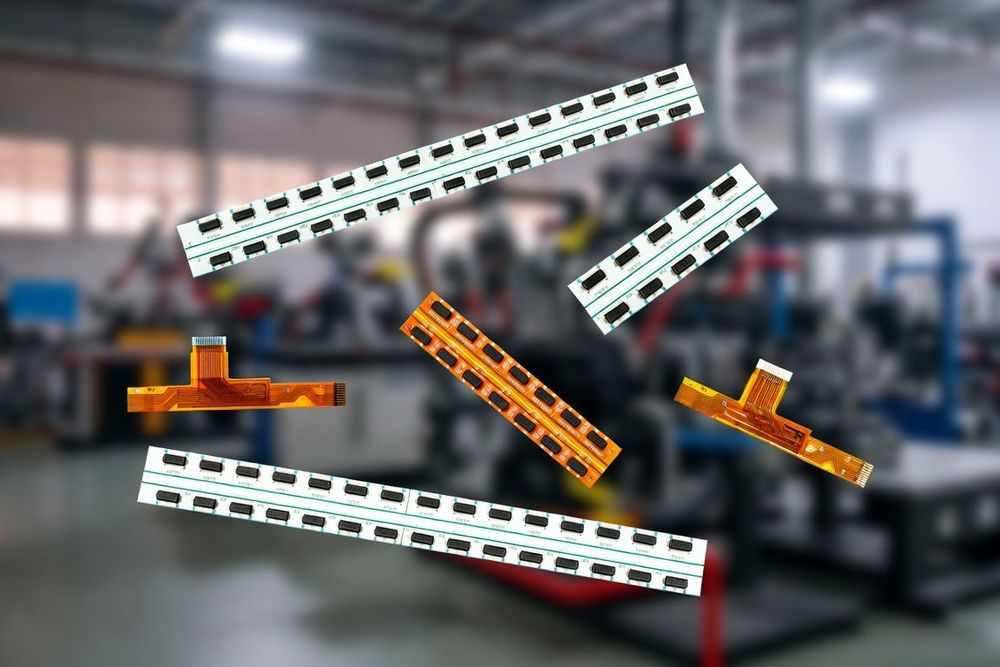
Distinguishing FFC and FPC Technologies
While Flexible Flat Cables (FFC) and Flexible Printed Circuits (FPC) are both widely used to route signals through space-constrained hardware enclosures, they are fundamentally different in their manufacturing processes, structural capabilities, and cost profiles.
Confusing FFC and FPC specifications often leads to over-engineering simple jumper links or under-specifying complex signal paths.
Construction and Manufacturing Differences
Understanding how each cable type is fabricated reveals its inherent physical and electrical limitations.
Flexible Flat Cables (FFC)
- Manufacturing Process: FFCs are manufactured via an automated continuous lamination process. Straight, parallel flat copper conductors are sandwiched between top and bottom layers of insulation film (typically PET or polyimide) coated with adhesive.
- Geometric Limits: FFCs are strictly linear jumper cables. All conductors run parallel to each other at a fixed pitch (e.g., 0.5mm, 1.0mm, or 1.25mm) from end to end.
- Tooling and NRE Costs: Extremely low or zero Non-Recurring Engineering (NRE) tooling cost. Manufacturers cut standardized laminated cable stock to custom lengths, strip the ends to expose copper, and apply stiffener tape.
Flexible Printed Circuits (FPC)
- Manufacturing Process: FPCs are fabricated using photolithographic etching processes identical to rigid printed circuit boards. Copper foil laminated to a polyimide film substrate is chemically etched to form conductive trace patterns.
- Geometric Limits: FPCs can feature non-linear shapes, complex outlines, branching arms, varying trace widths, surface-mount component pads, multi-layer routing, and controlled-impedance differential pairs.
- Tooling and NRE Costs: High initial NRE costs. Fabrication requires photolithography photomasks, specialized laser cutting profiles, and custom lamination tooling.
Cost and Performance Selection Criteria
When deciding between FFC and FPC for a hardware design, evaluate these key criteria:
- Routing Complexity and Branching: If your connection requires straight point-to-point signal jumping between two parallel connectors, specify an FFC. If your interconnect must split into multiple branches, fit a complex 3D enclosure contour, or mount active SMT components, an FPC is strictly required.
- Unit Cost vs. Production Volume: FFCs are significantly cheaper per unit in low-to-medium volumes because they eliminate custom etching masks. For simple board-to-board interconnects, switching from a custom FPC to a standard FFC can reduce cable unit costs by up to 70%.
- High-Speed Signal Integrity: FPCs allow precise trace impedance matching (50Ω single-ended, 100Ω differential) with integrated ground reference planes, making them suitable for high-speed protocols like PCIe, USB4, and MIPI CSI/DSI. Standard FFCs lack ground planes and impedance control, restricting them to low-frequency signaling or power delivery.