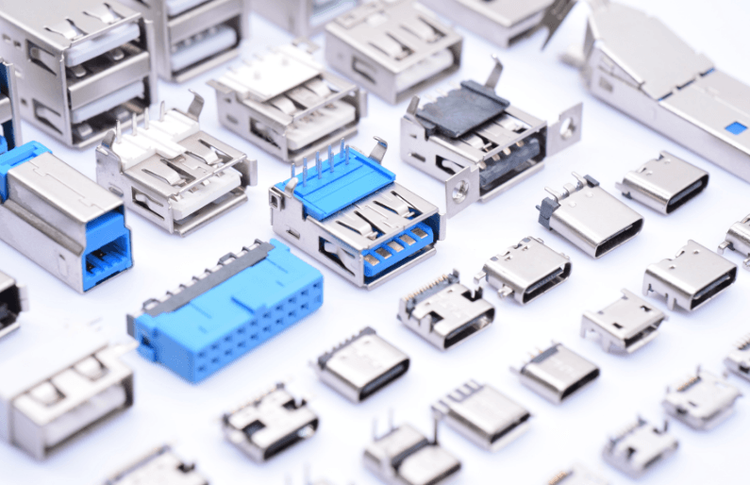
The Structural Backbone of Interconnects
Every connector system operates as a composite mechanical and electrical assembly. The shell and housing must provide electrical isolation, maintain absolute dimensional tolerances under extreme heat, and withstand mechanical installation stresses. Simultaneously, the internal contacts must act as spring elements, exerting predictable forces over years of service while carrying substantial electrical loads.
As automated assembly processes push reflow soldering temperatures above 260°C and high-density boards shrink pin spacing, the margins for material degradation disappear. Connector designers must evaluate raw material profiles down to the molecular and crystalline level to match application demands.
Contact Metallurgy — Selecting the Ideal Base Alloy
The choice of base metal determines the raw electrical conductivity and the mechanical spring characteristics of the receptacle contact. Engineers balance electrical conductivity (% IACS — International Annealed Copper Standard) against yield strength and stress relaxation resistance.
Brass (C26000 Series)
- Conductivity: High (~28% IACS)
- Characteristics: Highly economical, easily machined and stamped. However, brass exhibits poor yield strength and is highly susceptible to stress relaxation—the gradual loss of spring force under continuous mechanical strain—especially at elevated temperatures (>70°C).
- Applications: Ideal for commercial consumer items, stationary pins, or low-cost, low-cycle applications.
Phosphor Bronze (C51000 / C52100 Series)
- Conductivity: Moderate (~15% IACS)
- Characteristics: An excellent all-around engineering compromise. Phosphor bronze offers far superior fatigue life, elasticity, and yield strength compared to brass. It retains its spring force reliably at temperatures up to roughly 105°C.
- Applications: The industry workhorse for signal connectors, card edges, and standard board-to-board systems.
Beryllium Copper (CuBe / C17200 Series)
- Conductivity: Good (~20% IACS)
- Characteristics: The gold standard for high-performance spring properties. Following heat treatment, Beryllium Copper achieves exceptional yield strength and hardness. It resists stress relaxation at sustained operational temperatures up to 150°C, allowing for ultra-thin contact geometries that still exert high normal forces.
- Applications: Critical military, aerospace, and automotive environments where failure is not an option and space constraints are extreme.
Thermoplastic Housings — Isolating the System
The plastic housing acts as the structural frame holding the contacts in perfect alignment. During printed circuit board (PCB) assembly, this housing must pass through a reflow oven where it faces extreme thermal shocks.
Polybutylene Terephthalate (PBT)
- Key Properties: Excellent dielectric strength, high chemical resistance, and crisp mechanical molding capabilities.
- Limitations: A relatively low heat deflection temperature. PBT cannot survive lead-free reflow profile temperatures (260°C peaks) and is prone to blistering or melting under modern SMT processing.
- Applications: Primarily wave-soldered through-hole components, automotive wire harnesses, and industrial cable assemblies.
Polyamides (PA / Nylon, including PA46 and PA9T)
- Key Properties: Exceptionally high toughness, excellent flexural modulus, and good thermal resistance capable of handling reflow temperatures.
- Limitations: High hygroscopicity (moisture absorption). Nylon naturally absorbs atmospheric water molecules, which lowers its glass transition temperature and causes dimensional swelling. During reflow, this absorbed moisture can quickly turn to steam, causing localized structural outgassing or "popcorning."
- Applications: SMT connectors, header blocks, and heavy-duty industrial framing.
Liquid Crystal Polymer (LCP)
- Key Properties: The premium material choice for fine-pitch SMT connectors. LCP exhibits an extremely low melt viscosity, allowing it to easily flow into ultra-thin walls (<0.15 mm) without flashing. It has near-zero moisture absorption, exceptional dimensional stability, and easily withstands 260°C+ reflow profiles.
- Limitations: Highly anisotropic; its mechanical strength is significantly stronger along the direction of plastic flow during injection molding than across it, requiring careful weld-line engineering.
- Applications: High-density board-to-board connectors, smartphone sub-modules, and fine-pitch memory sockets.
Engineering Material Selection Matrix
Ultra-Fine Pitch SMT Connector (<0.4mm pitch): Optimal base metal — Beryllium Copper (CuBe); Optimal housing — Liquid Crystal Polymer (LCP). Justification: LCP fills micro-thin walls effortlessly; CuBe provides required spring normal forces at tiny geometric scales.
High-Current Automotive Engine Bay: Optimal base metal — High-Conductivity Copper Alloys; Optimal housing — High-Temperature Polyamide (PA) or PPS. Justification: High thermal ceiling resists structural degradation under vibration and high ambient heat.
Cost-Sensitive Commercial Through-Hole Header: Optimal base metal — Brass; Optimal housing — Polybutylene Terephthalate (PBT). Justification: Maximizes manufacturing efficiency and minimizes raw material costs where thermal loads remain low.
Material Integrity Dictates System Lifecycle
A connector specification is only as robust as the raw physical properties of its underlying materials. Choosing an inadequate plastic like PBT for an SMT line results in melted components in production, while picking an unstable base metal like brass for a high-vibration environment ensures contact relaxation and eventual field failure. By pairing advanced high-yield copper alloys like Phosphor Bronze or Beryllium Copper with thermally stable, low-moisture resins like LCP, engineers safeguard structural integrity from the assembly line to the field.